
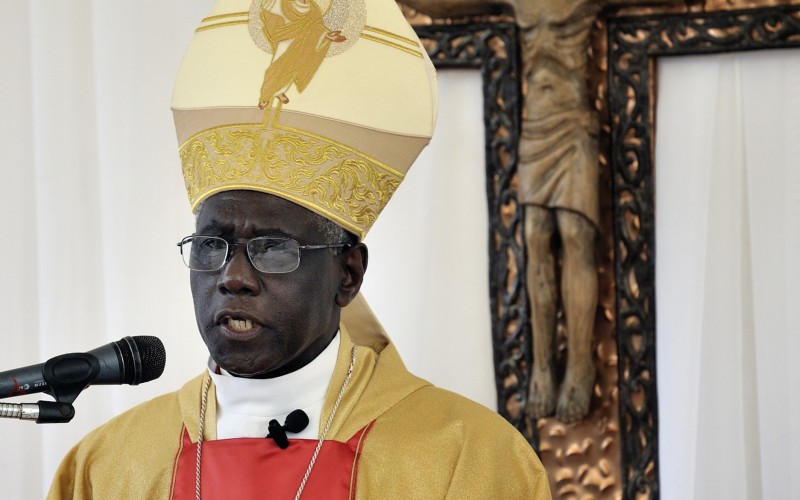
God or Nothing
A Conversation on Faith with Nicolas Diat
By Robert Cardinal Sarah
Reviewed by Todd Burud
“If man loses this orientation,
he has nothing left but to look at himself perpetually…” (1)
Africa is fast becoming one of the world’s strongest voices for the Catholic faith. It ranks first in the rate of increase of Catholics (41%), of priests (32.6%); and of seminarians (30.9%). These statistics (2) reflect a unique vitality, a growing leadership. And so, the Church looks increasingly to Africa for its bold defense of truth.
Twin threats to the family: gender ideology and ISIS
One strong, African voice spoke at the 2015 Family Synod. Cardinal Robert Sarah identified “two major threats to the family”(3): atheistic secularism and religious fanaticism, or more specifically, gender ideology and ISIS. One threat grows out of Western idolatry; the other, out of Islamic fundamentalism. One brings confusion; the other, subordination (4). Archbishop Ganswein, prefect of the Pontifical Household, calls them “an existential threat to human civilization par excellence” (5).
In response, Sarah joined with other African bishops in an effort “to help people find God through prayer, and especially through fidelity to the magisterium” (6). Their mission focuses on the West (7). And Sarah wrote his book, God or Nothing, to that end. At the book’s formal presentation in Rome (11/20/15), he explained the consequences of godlessness:
“God is disappearing from society, from culture, from the economy, no one is interested in God.” … “Without God,…we are nothing. Without God, man doesn’t now where he is, where he is going… Without God, we are lost.” (8).
The book’s title refers, not so much to a choice between God or atheism as it does to the state-of-man when God is absent in our lives. Without God, we live in a state of nothingness. Sarah’s book is an attempt to help turn people back to God.
Twin strengths to Sarah’s ministry: suffering and love
In God or Nothing, we discover the foundation for Sarah’s love of family, country, Church, and truth. He was born in the small village of Ourous in Guinea, Africa, in 1945. With profound gratitude, he recalls the work of the Holy Ghost Fathers when, in 1912, they founded a mission to convert his village from animism to Christianity. His father grew up in the animist religion, but “was baptized and married on the same day, April 13, 1947” (9). His parents farmed, and his family lived in a one-room brick hut (10). Sarah fondly recalls a happy childhood in a loving, devote home, and in communal charity among fellow villagers.
He also explains (in humble amazement) how he became the youngest bishop in the Catholic Church, at the age of thirty-four; how he withstood a Marxist regime as archbishop; and how he became Prefect of the Congregation for Divine Worship. Pope Benedict XVI chose him to head the Pontifical Council, Cor unum, saying, “I know that of all people, you have the experience of suffering and of the face of poverty” (11). The twin strengths of suffering and love helped to make truth a personal reality in his life.
“God is truth; through his Son, he [draws] us toward this truth.” (12)
According to Sarah, man is most noble when he seeks the truth, and most impoverished, when he does not (13). He describes how a love of truth, in turn, displays an intolerance (14) for what is false. Conditioned by political-correctness, we flinch at the very mention of intolerance. But in the Augustinian tradition (15), we distinguish the sin from the sinner. In so doing, we are intolerant of sin for the good of the sinner’s soul. The Church makes the same distinction. Ganswein quoted Reginald Garrigou-Lagrange, saying,
“The Church is, in her principles, intolerant, because she believes; and she is tolerant in practice, because she loves” (16).
To its detriment, our culture seems utterly unable or unwilling to admit this distinction. Grounded in relativism, it confuses rights for truth, mixing them together in an unsatisfying mulligan stew. For example, author, Anthony Esolen, describes how our culture tries to have it “both ways”:
We cannot have a culture of marriage and family and a pseudoculture of divorce and abortion; that is a contradiction. We cannot have a culture of marriage and family and a pseudoculture of indifference with regard to male and female… (17).
The threat of the West to other countries
Because he loves truth and the people he serves, Sarah is intolerant of the exported evils of Western culture. In general, everyone’s faith is threatened by exposure to the West’s relativism, atheism, humanism, and materialism. “If the West does not convert to Christ, it could end up making the whole world pagan” (18). We know these isms, first-hand, and readily empathize with Sarah’s concern.
But the West’s culture is not simply absorbed by smaller countries through a benign association. There’s something more deliberate here that demands our attention. The West also imposes its culture’s ideologies in a form Pope Francis calls, ideological colonization:
Pope Francis cautioned…that gender ideologies from the wealthy Western world are being imposed on developing nations by tying them to foreign aid and education, in a form of “ideological colonization.” (19)
According to Sarah, “Gender ideology has become the perverse condition for cooperation and development” (20). He calls it “an immoral and demonic deception” (21). Unfortunately, the West also imposes its gender ideologies upon Sarah’s beloved Africa, one of the world’s strongest voices for the Catholic faith. Sadly, this is not, in Churchill’s words, the West’s “finest hour”.
Our return to God starts with prayer and leads to an encounter
Sarah diagnoses the problem—our estrangement from God—and offers the remedy. He directs us back to God through prayer and through an encounter with Christ. “Prayer is the greatest need of the contemporary world; it remains the tool with which to reform the world” (22). Sarah reiterates the teachings of Benedict XVI on encountering, not an idea, but a Person:
In Deus Caritas est, Benedict XVI writes that at the origin of being Christian, there is not an ethical decision, a philosophical or moral idea, but an encounter with an event, a Person. … Christianity is Someone bursting into my life (23).
The quality of the interview depends upon the one interviewed
Generally, I’m not a fan of interview books. But the person interviewed makes the difference. John Paul II’s interview produced Crossing the Threshold of Hope; and Ratzinger, The Ratzinger Report and Salt of the Earth. They’re all best-sellers and filled with insight due to the phenomenal faith, intellect, and experience of the men interviewed. I think the same principle applies to Cardinal Sarah and his book. His intellect, faith, and experience make God or Nothing a strong witness to the Catholic faith.
*Prefect of the Congregation for Divine Worship and Discipline of the Sacraments
Notes:
1. God or Nothing, Cardinal Robert Sarah, 175-6.
2. Pontifical Yearbook 2016 and the Annuarium Statisticum Ecclesaie 2014, www.press.vatican.va. These percentages reflect the rate of change between 2005 and 2014.
3. Cardinal Sarah: ISIS and Gender Ideology are like ‘Apocalytic Beasts’, Edward Pentin, 12/12/15, www.ncregister.com
4. Ibid
5. Archbishop Ganswein Praises Cardinal Sarah for His Prophetic Witness, Edward Pentin, 11/21/15, www.ncregister.com
6. Cardinal Sarah on new book: I want to help people rediscover God, Elise Harris, November 21, 2015, www.catholicnewsagency.com
7. Archbishop Ganswein
8. Cardinal Sarah
9. God, 18
10. Ibid, 19
11. Ibid, 76
12. Ibid, 244
13. Ibid, 244
14. Ibid, 133
15. The City of God, book 14, chapter 6
16. Archbishop Ganswein
17. Defending Marriage, Anthony Esolen, 12-13
18. God, 146
19. Pope Francis Warns West Over ‘Ideological Colonization’, Alan Holdren/CAN/EWTN News, 1/29/15
20. God, 159
21. Ibid, 159-60
22. Ibid, 150
23. Ibid, 154